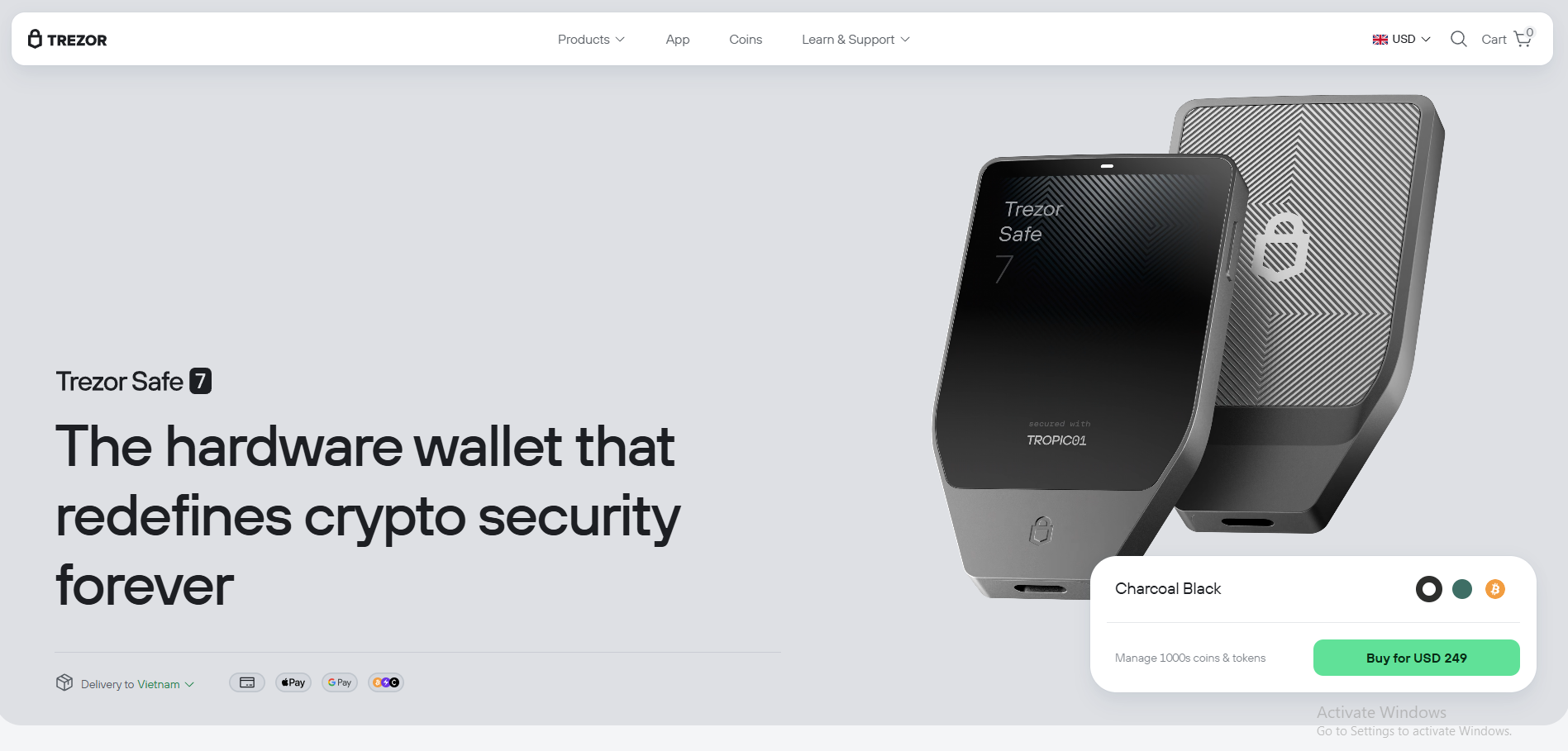
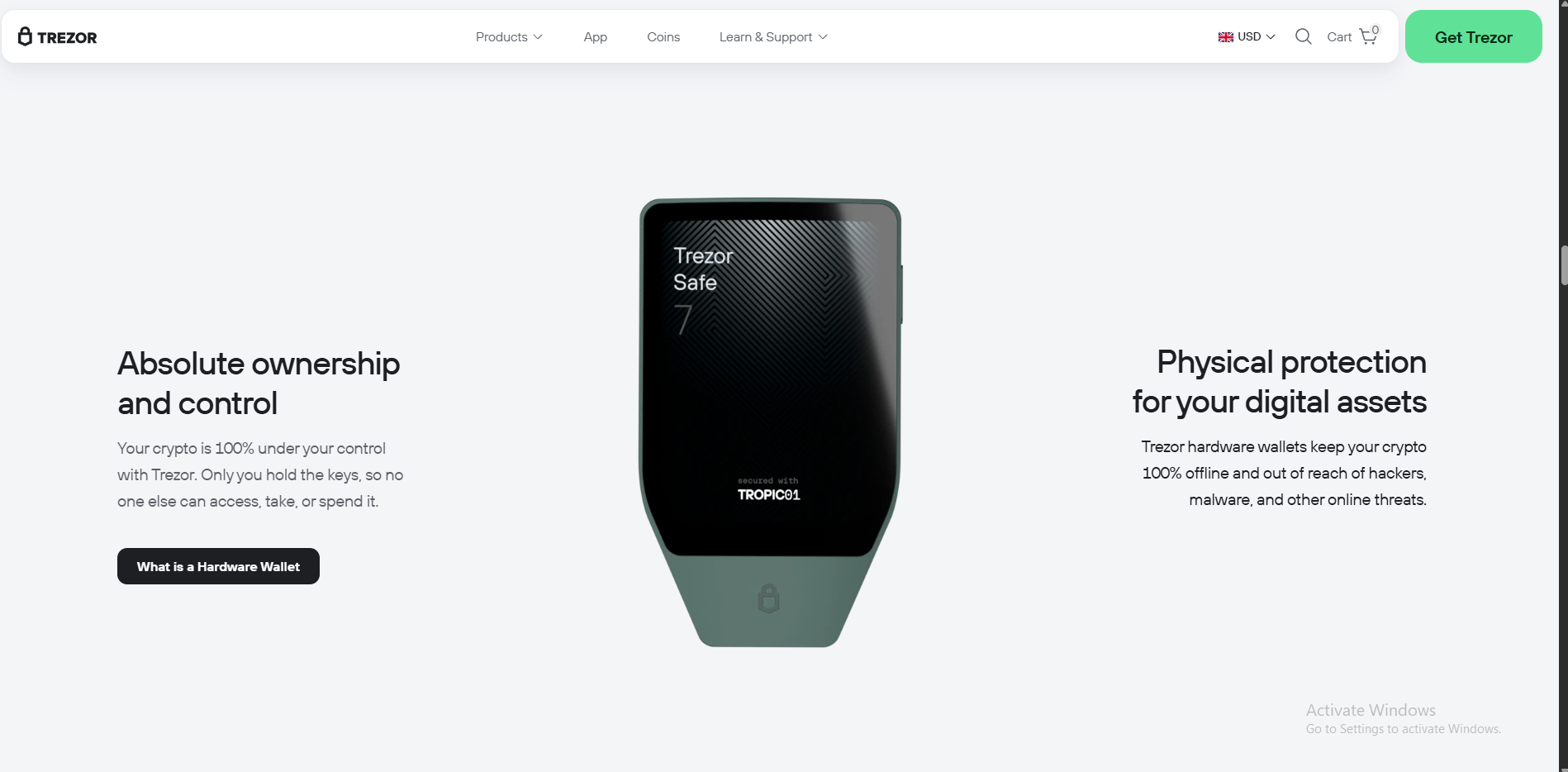
🔐 Overview of Trezor
If you strip away all the hype around crypto tools, Trezor solves one very specific problem: how to keep your crypto safe without trusting anyone else.
That might sound obvious—but it’s exactly where most people go wrong. Many users still store assets on exchanges or browser wallets, which are convenient but fundamentally exposed. Trezor flips that model entirely.
Instead of trusting a platform, you’re given a physical device that acts as your personal vault.
When you use Trezor, your private keys—the most sensitive part of your crypto—are generated and stored inside the device itself. They never leave it. Not to your laptop, not to the cloud, not to any server. Every action, from sending funds to confirming transactions, requires manual approval directly on the device.
That one design decision changes everything.
The platform behind it, Trezor.io, is where users explore and purchase the hardware, but also learn how to use it properly. It connects with the Trezor Suite, a management interface that gives you just enough control to operate safely—without turning into a bloated, all-in-one crypto app.
Unlike many modern crypto tools chasing convenience, Trezor takes a more focused approach:
- It doesn’t try to replace exchanges
- It doesn’t overload users with features
- It prioritizes security and ownership above all else
Another defining trait is its commitment to open-source development. Built by SatoshiLabs, Trezor allows anyone to inspect its code. This isn’t just a technical choice—it’s a trust model. Instead of asking users to believe in the system, it lets them verify it.
Trezor also supports a wide range of cryptocurrencies and works with external tools like MetaMask, which means you’re not locked into a single ecosystem. You can store assets securely while still interacting with the broader crypto world.
In simple terms, Trezor isn’t trying to be the most convenient tool—it’s trying to be the one you rely on when security actually matters.

✅ Pros of Trezor
The biggest strength of Trezor is not a feature—it’s a shift in mindset.
Once you start using it, you stop thinking in terms of accounts and platforms, and start thinking in terms of ownership. Your crypto isn’t “on an app” anymore—it’s secured by a device you control. That psychological shift alone is a major advantage, especially in a space where trust is often misplaced.
From a technical perspective, Trezor dramatically reduces exposure to common risks. Because private keys never interact with internet-connected systems, threats like phishing attacks, malware, or exchange breaches become far less dangerous. Even if your computer is compromised, your funds remain protected as long as the device itself is secure.
Another standout advantage is its transparency. Being fully open-source means Trezor doesn’t operate behind closed doors. Security researchers, developers, and even curious users can inspect how it works. This creates a level of accountability that’s rare—not just in crypto, but in tech in general.
Trezor also benefits from its longevity. It’s not a new startup trying to gain traction—it’s a product that has survived multiple market cycles, adapted to industry changes, and built a reputation over time. In a space where projects disappear overnight, that kind of stability matters.
In terms of usability, Trezor is more approachable than people expect. The setup process is guided, the interface is clean, and once configured, day-to-day usage is straightforward. It doesn’t try to hide complexity—it simply organizes it in a way that makes sense.
Flexibility is another key strength. Trezor doesn’t lock you into a closed ecosystem. You can connect it to different wallets, explore decentralized apps, or use it purely for long-term storage. It adapts to your level of involvement rather than forcing a specific workflow.
Ultimately, what Trezor offers is peace of mind—not through flashy features, but through a system that removes unnecessary risk. And in crypto, that’s often the most valuable feature of all.

❌ Cons of Trezor
If Trezor feels “serious,” that’s because it is—and that seriousness comes with trade-offs.
First, there’s the philosophy vs convenience problem. Trezor is built around control and transparency, not ease. That means it doesn’t try to simplify everything for you. Tasks like interacting with DeFi, staking, or managing multiple chains often require external tools instead of being fully integrated. For experienced users, this is freedom. For beginners, it can feel like unnecessary friction.
Then there’s the security design debate. Trezor intentionally avoids the Secure Element approach used by competitors like Ledger. Instead, it relies on open-source architecture. While this makes the system transparent and auditable, it also means less hardware-level protection against physical attacks. Realistically, this only matters in very specific scenarios—but it’s one of the few areas where Trezor doesn’t aim to be the “strongest,” just the most transparent.
Another limitation is how unforgiving self-custody really is. Trezor doesn’t protect you from your own mistakes. If you:
- Lose your recovery phrase
- Store it insecurely
- Fall for phishing
👉 Your funds are gone. Permanently.
That’s not a flaw in the product—it’s the reality of true ownership. But it’s also the biggest barrier for new users.
On the hardware side, Trezor feels functional rather than modern. No Bluetooth, no seamless mobile experience, and a design that prioritizes reliability over aesthetics. Compared to newer devices, it can feel slightly outdated—even if it still does its job perfectly.
Finally, there’s the risk outside the product itself: counterfeit devices. Like all hardware wallets, Trezor must be purchased from official sources. The device is secure—but the buying process is where users can make costly mistakes.

💰 Pricing of Trezor
Trezor’s pricing doesn’t try to impress—it tries to make security accessible first, and premium features optional.
At the base level, the Trezor Model One (~$69) is enough to secure your crypto properly. That’s what makes Trezor interesting: you’re not forced to buy the expensive version to be safe. The fundamentals—offline keys, transaction verification, self-custody—are already there.
Then comes the newer generation like Trezor Safe 3 (~$79–$99). This is where most users should look. It feels like a refined version of the original idea—same philosophy, better execution. For the majority of people, this tier offers the best balance between cost and usability.
At the top, you have models like Trezor Model T (~$179–$220). Here, you’re paying for comfort:
- Touchscreen input
- Easier navigation
- Smoother user experience
But importantly, you’re not buying more security—just better interaction with the same system.
Compared to Ledger, Trezor stays competitive:
- Slightly cheaper at entry level
- Similar pricing in mid-range
- Less focused on premium hardware features
What stands out is the one-time cost model. No subscriptions, no upgrades locked behind paywalls. You buy the device, and it works—indefinitely.
But here’s the real perspective shift:
Trezor isn’t expensive because of what it does.
It’s expensive because of what it prevents.
If you’re holding small amounts of crypto, the price may feel unnecessary. But once the value grows, the cost of not using something like Trezor becomes much harder to justify.